
Culture: The Third Alignment Required to Achieve Success
In the past, much has been written about law firm success being highly dependent on compensation and on strategy alignment; however, a
3-part alignment, including culture, is what really drives law firm success!
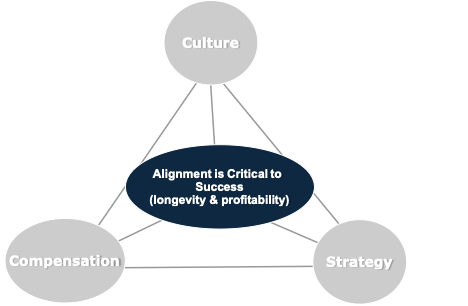
A law firm's culture is the daily manifestation of its explicit performance expectations and implicit behavioral norms: what is tolerated, what is overlooked, and what is rewarded.
Just be aware that that picture might be jarringly dissimilar to the one you imagine.
A firm's culture—its performance expectations and behavioral norms—is ultimately driven by the firm's values: the truest principles and desired outcomes that guide decision-making and govern the resolution of conflicts over priorities.
Simple definition: How things get done around here!
What makes culture important enough to be seen as critical to a law firm's success?
A law firm's culture is important because it is the foundation that enables strategy, attracts talent, retains clients, and drives sustainable growth.
In particular, culture is critical because:
Execution of strategy depends on culture. Even the best strategic plan fails if the firm's values, norms, and daily behaviors don't support it.
Talent engagement and retention: Lawyer satisfaction rises significantly in cultures with a long-term focus, collegial management, and consistency between what leaders say and what the firm actually rewards.
Client trust and brand strength: Culture shapes how clients experience the firm — responsiveness, collaboration, communication style, and reliability.
Is there anything driving your firm's success today more than profitability, recruitment, client satisfaction, and innovation?
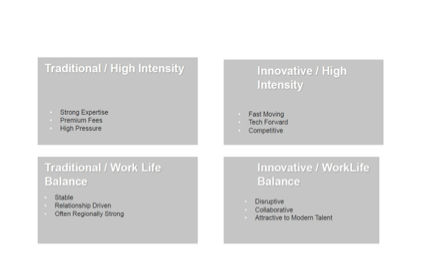
While the degree/intensity of law firm cultures has changed over time, research indicates that law firms generally possess one of the following four cultural footprints:
Law firm culture rarely dies from a single major event, but rather from repeated actions (or inactions) that slowly erode trust, clarity, and cohesion.
These actions or inactions, often referred to as "killer behaviors/actions," can include:
Double standards and exceptions for rainmakers
When high‑revenue partners are allowed to ignore deadlines, mistreat staff, or bypass firm policies, you signal that values are optional and billables matter more than people.
Poor communication or selective communication
When leadership makes decisions without explaining the "why," people fill in the blanks — usually with negative assumptions.
Rewarding mediocrity or ignoring underperformance
Allowing missed deadlines, sloppy work, or inconsistent behavior to go unmanaged is a disservice to underperformers and a demotivator for performers.
Leadership avoidance
Avoiding difficult conversations, failing to address toxic behavior, or delaying decisions creates problems that metastasize and become harder to fix.
Politeness-over-problem-solving
Cultures that prioritize "being nice" over addressing issues directly create gossip, frustration, and passive‑aggressive behavior.
Operating from fear instead of purpose
When lawyers react defensively, hoard information, or protect turf, the firm's emotional climate shifts from self‑actualization to fear — leading to anger, jealousy, and apathy.
It is common for law firms to describe their cultures as 'collegiate', ' respectful ', and 'friendly'. In these tough times, just being nice isn't enough. It is incumbent on every professional service leader to strive for a cohesive, productive, healthy, innovative, and disciplined culture.
So, if your firm is exclusively focusing on strategy to guide them through these challenging times, remember Peter Drucker's quote that has stood the test of time: "Culture eats strategy for Breakfast".
Who is Stephen Mabey?
Stephen Mabey is a CPA, CA, and the Managing Director of Applied Strategies, Inc. His credentials include:
Fellow of the College of Law Practice Management (one of 19 Canadians – 276 Fellows);
Author of Leading and Managing a Sustainable Law Firm: Tactics and Strategies for a Rapidly Changing Profession and Co-author of Key Performance Indicators For Your Legal Practice: Measuring Success and Driving Growth
A founding partner of East Coast Legal Ops
More than 25 years in a senior management role with Stewart McKelvey, a 220-lawyer, six-office Atlantic Canadian law firm;
Over 16 years of providing advice and counsel to small to mid-size law firms on a broad range of issues;
Panelist and facilitator of the Managing Partner Information Exchange ("MPIE") at the annual Managing Partner Forum Leadership Conference held in Atlanta, Georgia.
A free group mailing list that circulates articles, directly and indirectly, impacts law firms.
He has been advising law firms for over 16 years on a wide range of issues, including - strategic action planning, leadership, understudy (succession) planning, compensation - both Partner and Associate, organizational structures and partnership arrangements, business development, capitalization of partnerships, partnership agreements, lawyer & staff engagement, marketing, key performance indicators, competitive intelligence, finance, mergers, and practice transitions.
Applied Strategies Inc.'s website contains testimonials from clients describing the value of the services rendered https://www.appliedstrategies.ca/client-testimonials.
Steve can be reached by email – smabey@appliedstrategies.caor phone at 902.499.3895